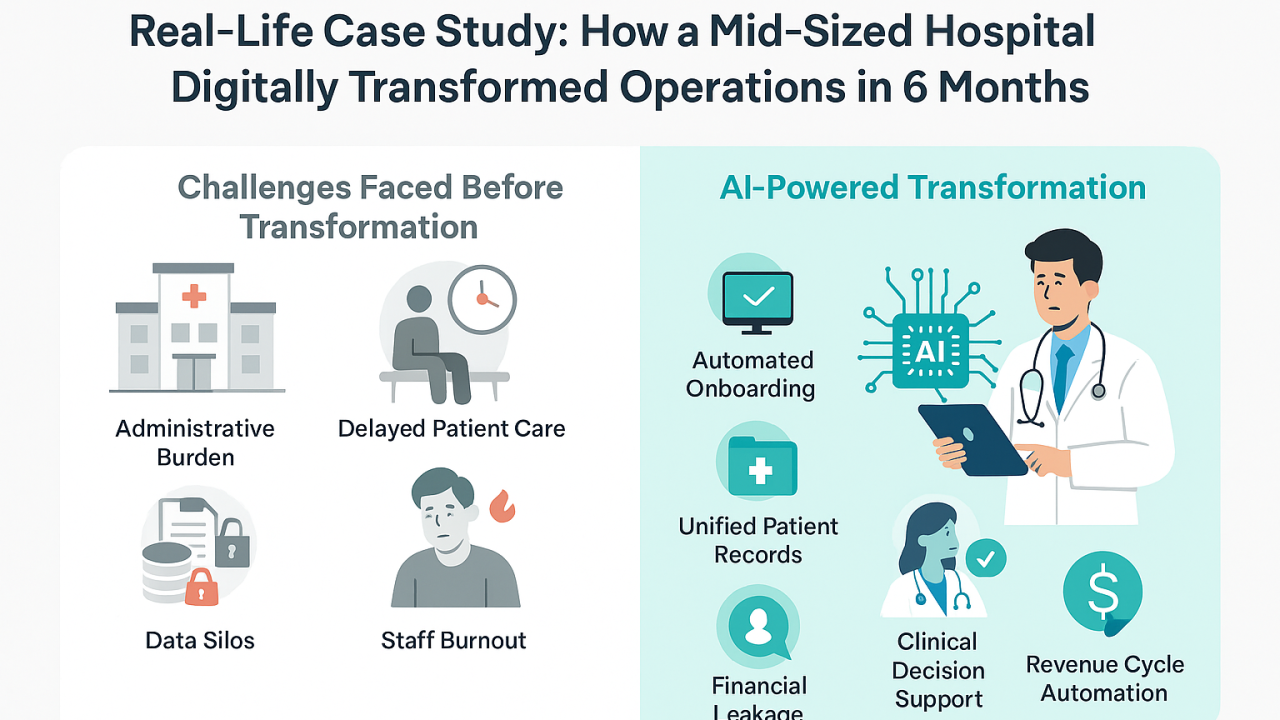
Healthcare has always been about saving lives and improving patient outcomes, but behind the scenes, hospitals often struggle with operational inefficiencies. In this illustrative scenario, we walk through how a typical mid-sized hospital can overcome critical challenges and digitally transform operations within six months using AI Automations and AI Agents.
Common Challenges Before Transformation
- Administrative Burden – Staff spend hours on repetitive tasks like patient intake, appointment scheduling, and insurance verification.
- Delayed Patient Care – Manual processes slow down diagnosis, treatment planning, and discharge procedures.
- Data Silos – Patient records, lab results, and medical histories are scattered across multiple systems.
- Staff Burnout – Nurses and doctors are overwhelmed with non-clinical work, leaving less time for patient care.
- Financial Leakage – Inefficiencies in billing and claims processing lead to revenue loss.
How AI Automations & AI Agents Help
- Automated Patient Onboarding – AI-powered chatbots and voice assistants handle intake forms, freeing front-desk staff.
- Smart Scheduling – AI agents optimize appointment scheduling to reduce wait times and increase efficiency.
- Unified Patient Records – AI integrates disparate data sources into a single, easily accessible dashboard.
- Clinical Decision Support – AI agents assist doctors by analyzing patient data and suggesting possible diagnoses.
- Revenue Cycle Management – Automated billing and claims submission reduce errors and improve cash flow.
What to Measure After 6 Months
Digital transformation in healthcare is not a distant vision, it is happening now. With the power of AI Automations and AI Agents, hospitals can deliver better patient care, streamline operations, and boost financial outcomes, within months, not years.
- Patient wait times
- Staff productivity and time spent on non-clinical work
- Administrative error rates
- Patient satisfaction scores
- Claims accuracy and recovered revenue