The Skills & Downtime Challenge in Industrial Operations
Industrial organizations face a growing set of challenges:
Traditional training methods, manuals, classroom sessions, shadowing experts, are often slow, inconsistent, and risky.
This is where Augmented Reality (AR) and Virtual Reality (VR) are changing the game.
- Skilled labor shortages
- Increasingly complex machinery
- High training costs
- Safety risks during hands-on learning
- Long mean-time-to-repair (MTTR)
AR vs VR in Industrial Settings
While often grouped together, AR and VR serve different but complementary purposes:
Together, they enable faster learning, safer operations, and smarter maintenance.
- AR (Augmented Reality): Overlays digital instructions, visuals, and data onto the real-world environment
- VR (Virtual Reality): Creates fully immersive simulations for training without real-world risk
How AR/VR Is Transforming Industrial Training
Immersive, Hands-On Learning Without Risk
VR allows workers to train on complex or hazardous equipment in a safe, simulated environment, covering equipment operation, safety drills and emergency scenarios, process walkthroughs, and new hire onboarding.
Impact: Faster skill acquisition with zero production risk.
Standardized Training Across Locations
AR/VR ensures every worker receives the same training experience, regardless of site or instructor.
Impact: Consistent skill levels, fewer errors, and faster scaling across plants.
Faster Knowledge Transfer from Experts
Expert workflows can be captured once and reused endlessly.
Impact: Tribal knowledge is preserved and shared across generations of workers.
AR/VR in Maintenance & Field Operations
Guided Maintenance & Repairs (AR)
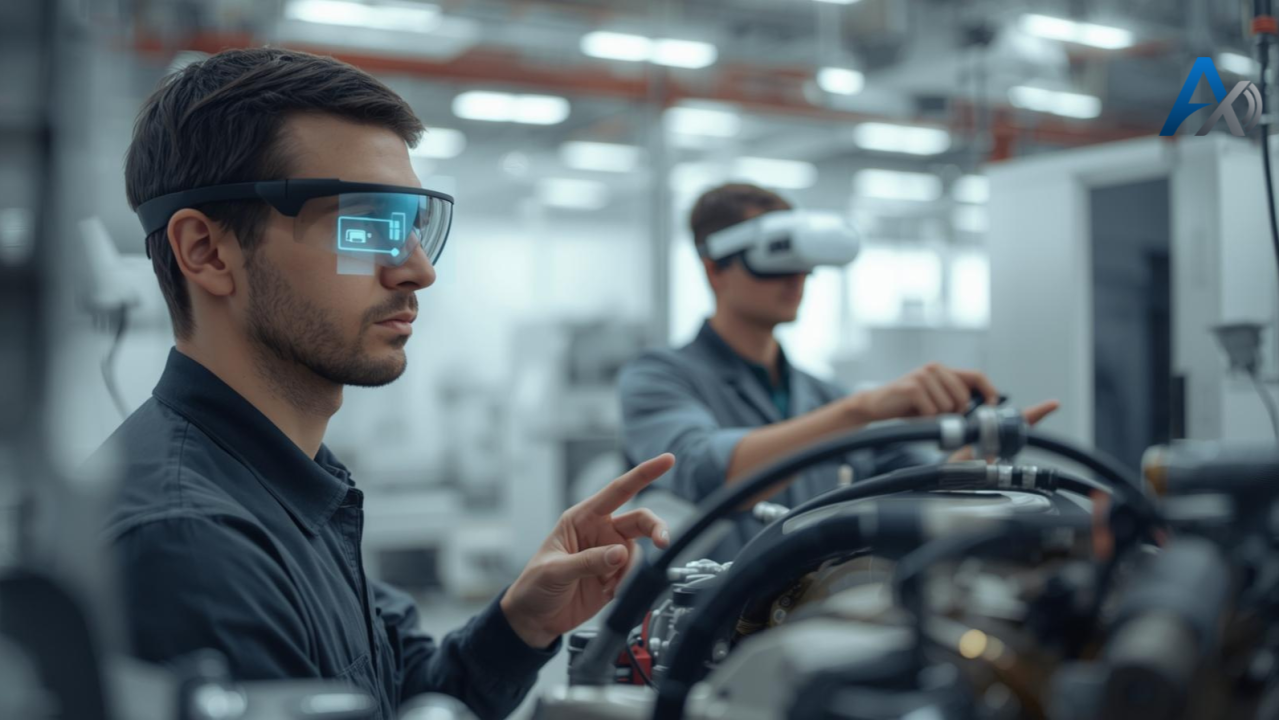
Technicians use AR headsets or tablets to see step-by-step repair instructions, highlighted components, torque values and safety warnings, and real-time sensor data.
Impact: Reduced errors, faster repairs, and higher first-time fix rates.
Remote Expert Assistance
AR enables remote experts to see what the technician sees, annotate the technician's field of view, and guide repairs in real time.
Impact: Less travel, faster resolution, and reduced downtime.
Predictive Maintenance Meets AR
When combined with IoT and AI, AR alerts technicians before failures occur, maintenance tasks are prioritized intelligently, and instructions adapt based on machine condition.
Impact: Maintenance becomes proactive instead of reactive.
Safety & Compliance Benefits
AR/VR improves safety by training workers before exposure to hazards, providing real-time safety warnings, ensuring correct procedures are followed, and supporting compliance documentation.
Impact: Fewer incidents and stronger regulatory compliance.
Business Impact of Industrial AR/VR
Organizations adopting AR/VR can expect:
- Faster training times
- Fewer maintenance errors
- Lower downtime and MTTR
- Improved workforce confidence
- Reduced reliance on on-site experts
- Better safety outcomes
What's Next?
The future of industrial AR/VR lies in integration:
AR/VR is evolving from a training tool into a core operational capability.
- AR + IoT for real-time machine context
- AR + AI for adaptive instructions
- Digital twins for simulation-based learning
- Wearable devices integrated with enterprise systems
Final Thought
Industrial AR and VR are not futuristic experiments, they are practical technologies delivering real value today.
By transforming how workers learn, maintain equipment, and collaborate, AR/VR helps organizations build safer, smarter, and more resilient operations.